I have a love/hate relationship with JoAnn's "red tag" fabrics racks.
On the first hand, they're a mess. Organization is at a minimum, and the bolt labels are iffy at best. (Knowing how to do a burn test is a valuable skill.) On the other hand, if you're willing to treat the red tag rack like a thrift shopping excursion, some gems will emerge.
Tuesday, July 5, 2016

Tuesday, March 1, 2016
Putting the "Punk" in Steampunk
Beside the Victorian aesthetic and the science fiction focus, it's important to note that Steampunk is punk. Interestingly enough, lots of us Steampunks are age-peers to those 70's punk rockers. We haven't changed our philosophies, just our style. Even with the kids and the cube-farm jobs, we're still punk.
It was only in the past 40 years that the term "punk" has come into the vernacular, notably by their elders to describe the British youth counter-cultural movement deemed to be "worthless young hoodlums" inspired by loud raucous music and trashy clothing. (Had they thought of it, I'm sure that the same could be said about the 60's and the 50's, and....) It's been said that to define "punk" is to create a cultural norm, and well, that's not punk. But we've got a lot in common with the Punk Rock Girl. We're countercultural, outré, anti-consumerist, individualistic and anti-authoritarian, we have a sense of the unexpected or shocking (we're okay wearing unconventional clothing out in public!), and we're free thinkers and discontent with societal norms, attitudes, and mores, because in some way Victorian seems more authentic. And yet, we turn Victorian norms, attitudes and mores on their collectively elegant top hats. We put corsets on the outside, and ladies are bad-asses with weapons. If that's not p-u-n-k, I don't know what is.
Where is the punk in Steampunk?
Generally, Steampunk is defined as an alternate future as seen from the Victorian past. My position is that we begin with a Victorian aesthetic, meld it with a punk ideology, and then invent alternate futures in which to frame the style. Which is of course, open to interpretation.
Sure, there are pioneers like Diana Vick and G. D. Falksen, but their aesthetic is constantly under fire. Everyone's a critic. There are endless debates about what's Steampunk, what's not, and what's Steampunk "enough". We parse into Clockpunk, and accuse people of edging into Dieselpunk or Cyberpunk, and some people say that it's okay too.
It was only in the past 40 years that the term "punk" has come into the vernacular, notably by their elders to describe the British youth counter-cultural movement deemed to be "worthless young hoodlums" inspired by loud raucous music and trashy clothing. (Had they thought of it, I'm sure that the same could be said about the 60's and the 50's, and....) It's been said that to define "punk" is to create a cultural norm, and well, that's not punk. But we've got a lot in common with the Punk Rock Girl. We're countercultural, outré, anti-consumerist, individualistic and anti-authoritarian, we have a sense of the unexpected or shocking (we're okay wearing unconventional clothing out in public!), and we're free thinkers and discontent with societal norms, attitudes, and mores, because in some way Victorian seems more authentic. And yet, we turn Victorian norms, attitudes and mores on their collectively elegant top hats. We put corsets on the outside, and ladies are bad-asses with weapons. If that's not p-u-n-k, I don't know what is.
Where is the punk in Steampunk?
Steampunk is hard to define
If you're newish to the Steampunk culture, you've probably heard all sorts of definitions, from the very limited to virtually no definition at all. Controversy rages over what is and isn't Steampunk, whether it's a science fiction or a fantasy genre, and whether you can really do a "Steamunk Boba Fett" or not. Predictably, when virtually nothing is set in stone and everyone's a critic, creating something that's identifiably Steampunk can be fraught with all sorts of anxieties.Generally, Steampunk is defined as an alternate future as seen from the Victorian past. My position is that we begin with a Victorian aesthetic, meld it with a punk ideology, and then invent alternate futures in which to frame the style. Which is of course, open to interpretation.
Steampunk has no style authority
The style is largely self-defined, based on everyone's mental image derived from literature, and (conventionally) based on Victorian aesthetics. Steampunk style reflects the taste, style, and aesthetic of the maker. Often that aesthetic is unconventional, juxtaposing dissimilar materials, leaving exposed raw (or burned!) edges, or mis-matching buttons.Sure, there are pioneers like Diana Vick and G. D. Falksen, but their aesthetic is constantly under fire. Everyone's a critic. There are endless debates about what's Steampunk, what's not, and what's Steampunk "enough". We parse into Clockpunk, and accuse people of edging into Dieselpunk or Cyberpunk, and some people say that it's okay too.
Steampunk is a maker culture
We put a high value on self expression. Like those 70's punk rockers, we make our own clothing, and write our own music. The Steampunk ensembles that you see at a convention represent hours and hours of effort, a vast skillset, and likely years of experience in those skillsets. Makers create for ourselves, but also for others in the community to purchase to enhance their impressions. We have an active literary and musical tradition, which supports both musicians and authors, but also professional artists who create book covers and album covers.
Steampunk is anti-consumerist
We prefer to make instead of buying, unless it's from another Steampunk maker. And when we make, we very often upcycle, haunting thrift stores for second-hand clothing to mod. We take apart machinery for the interesting pieces. We find unconventional ways to use conventional objects. Door knobs become walking stick handles, and bed ruffles become petticoats. Virtually anyone can access the anti-consumerist philosophy; if you can sew on a button, you can make mods to second hand clothing to make it more steamy. More accomplished sewers will find chinos to mod into plus-fours, or be able to convert a velvet jacket into an opera coat.
The irony about punk is that as soon as it becomes popular and mainstream, it's no longer punk. It becomes passe, a trope. In fact, as soon as D&G creates a steamy range of men's clothing (they did), Steampunk is very firmly in the mainstream. It seems that popularity tarnishes the genre for some, and they move on to other more edgy genres. I think that it means that Steampunkers simply need to keep creating and inventing - and yes, refining - the genre.
And the ultimate irony is about to come to fruition - all that out-out-of-fashion mainstream Steampunk clothing will be in the thrift shops next year. And the counter-cultural, anti-consumerist Steampunk will be able to upcycle that clothing into their own wardrobe.
How punk is that?
How punk is that?
Monday, September 15, 2014
Belle epoch beverage on a budget
 |
| A typical Pontarlier absinthe glass, with a reservoir and faceting. 8 ounces capacity and 5.5" tall. Generally available at between $16 and $20. |
During the heyday of absinthe, the glassware used was somewhat less prescribed than one might think. Barware that was used for absinthe fell into two categories, glasses used only for absinthe and glasses used for both absinthe and other drinks. Additionally, glassware used in bistros was by necessity rather sturdy due to rough use, so light, delicate glasses are not suitable.
Typical styles of general purpose glassware include the Mazagran, the Lyonaisse, and the Chopes Yvonne. All of these are footed forms, with a short and often ornate stem. The bowl is funnel-shaped, with almost uniformly straight sides that do not narrow at the lip.
 |
| A pressed glass or depression glass style of water glass. The shape is lovely and the oak leaf design will play nicely with the swirling absinthe. 5" tall and 8 ounce capacity. This glass cost me $.75. |
Fortunately, the shapes of the old general purpose bistro glasses are still manufactured, usually designated as "water" glasses. Even more fortuitously, stemmed water glasses seem to be superfluous table wares in today's increasingly casual dining habits. The result is that they frequently turn up in thrift stores. And thus I have started building my collection of bar ware suitable for serving absinthe.
Here are some glasses that I've picked up recently. Most would fall into the "general purpose barware" category. I'm looking for the typical funnel shapes, between 5" and 7" tall, with a short and sometimes ornate stem. The capacity must accommodate the "dose" and the three to five parts of ice water which is required to release the oils from the alcohol and create the cocktail - so between 4 and 8 ounces.
I've had to make a couple of concessions to modern sensibilities in that many of the available glasses have etching on them in floral patterns. Considering that absinthe is an herbal spirit, it doesn't seem inappropriate.
 |
| This is an okay shape, similar to a Torsade, but without the twist at the bottom. Arguably a little large at 12 ounces capacity, but I really like the "gem" on the stem; it's placed nicely for holding. 6.5" tall. A buck each at the thrift store. |
I've had to make a couple of concessions to modern sensibilities in that many of the available glasses have etching on them in floral patterns. Considering that absinthe is an herbal spirit, it doesn't seem inappropriate.
 |
| The glass ball on the stem is not hollow, which is the only material difference between this glass and the typical Pontarlier profile. Large capacity at 12 ounces, 7" tall. |
 |
| This glass was the real "find". Not only is it the right shape, but the bottom of the bowl - up to the top indentation - is exactly an ounce; it may have not been manufactured for absinthe, but it's a reservoir glass. It's 6.5" high and has a 10 ounce capacity. $2.99 each at the thrift store. |
I think I've got enough, but there are one or two more thrift stores that I haven't yet relieved of absinthe wares. In other thrift store findings, I've picked up a footed crystal flat wide sugar dish and an amber glass vase for holding spoons. But you'll have to come to the tasting to see those.
Wednesday, July 9, 2014
Dress Diary: 1890s Belle Epoch Steampunk evening gown - Resources and inspirations
In the planning stages of a Steampunk'd Belle Epoch gown for our Georgetown Loop Excursion later this month.
I'm looking at Worth gowns, and trying to tweak them from straight-ahead Victorian to Steampunk. My usual motif involves trims like buttons and swags of chains... and I decided that the fabrics and accessories would probably be the best way to carry the Steampunk theme.
I don't have the patterns yet, and am headed to Colorado Springs to pick up a set on Friday. (This means that this weekend will be all sewing, all the time.) I'll be using Truly Victorian's 1892 ball gown bodice and 1893 bell skirt; so, a-line skirt with a full train and a pointed bodice with big poufy sleeves. I've done some sketches that look remarkably like Disney princess dresses. Which makes me go "hmmm..."
I have suitable fabrics in my stash, but as I'm finding not quite enough of any one piece. This will necessitate a trip to Colorado Fabrics to find a couple of suitable complimentary yards. I'll be using the cerise and beige strip that I got from Clare a few months ago, and I have some georgette and ecru/gold embroidered netting for embellishing. Hoping I can find something complimentary to fill out the skirt. I've seen Worth gowns with contrasting gores, so it's not outrageous.
As I was mulling over the design, I started thinking: accessories are where the Steam really happens. I can't do leather belts and holsters and pouches with this one though. But I can do steamy head wear, and pieces for neck and wrist. I think that here is where the Steam happens. (And work on them before I get the patterns!) I have a couple of plaque bracelet to disassemble and then mount the plaques on confections of lace and beads and chain - on for neck and one for right wrist. However, a dive into stash last night revealed lots of Gothique elements, but not enough steamy ones... so another line on my shopping list.
And looking at my project management spread sheet, I was reminded that I have a couple of preliminary things that have to be done - I have a petticoat that needs to be re-assembled with a suitable amount of pouffiness to support the Belle Epoch skirt. Which is good, because I can't start on that dress until I get the patterns on Friday.
I'm looking at Worth gowns, and trying to tweak them from straight-ahead Victorian to Steampunk. My usual motif involves trims like buttons and swags of chains... and I decided that the fabrics and accessories would probably be the best way to carry the Steampunk theme.
I don't have the patterns yet, and am headed to Colorado Springs to pick up a set on Friday. (This means that this weekend will be all sewing, all the time.) I'll be using Truly Victorian's 1892 ball gown bodice and 1893 bell skirt; so, a-line skirt with a full train and a pointed bodice with big poufy sleeves. I've done some sketches that look remarkably like Disney princess dresses. Which makes me go "hmmm..."
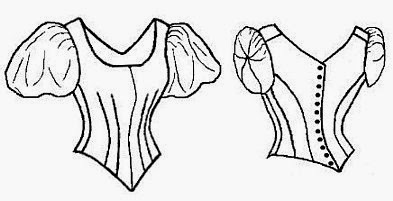 |
| TV490 1892 Ball Gown bodice |
 |
| TV292 1893 Bell skirt |
I have suitable fabrics in my stash, but as I'm finding not quite enough of any one piece. This will necessitate a trip to Colorado Fabrics to find a couple of suitable complimentary yards. I'll be using the cerise and beige strip that I got from Clare a few months ago, and I have some georgette and ecru/gold embroidered netting for embellishing. Hoping I can find something complimentary to fill out the skirt. I've seen Worth gowns with contrasting gores, so it's not outrageous.
As I was mulling over the design, I started thinking: accessories are where the Steam really happens. I can't do leather belts and holsters and pouches with this one though. But I can do steamy head wear, and pieces for neck and wrist. I think that here is where the Steam happens. (And work on them before I get the patterns!) I have a couple of plaque bracelet to disassemble and then mount the plaques on confections of lace and beads and chain - on for neck and one for right wrist. However, a dive into stash last night revealed lots of Gothique elements, but not enough steamy ones... so another line on my shopping list.
And looking at my project management spread sheet, I was reminded that I have a couple of preliminary things that have to be done - I have a petticoat that needs to be re-assembled with a suitable amount of pouffiness to support the Belle Epoch skirt. Which is good, because I can't start on that dress until I get the patterns on Friday.
Subscribe to:
Posts (Atom)